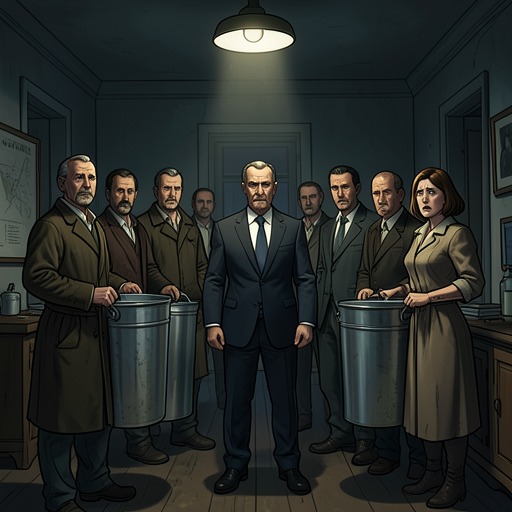
Mike Baye
Hold TightMike Baye is a transplant physician whose steady routines cannot shield him from the private crisis unfolding in his family: his son Adam has withdrawn, and Mike and Tia have entered a room that seems to belong to a stranger. As Mike searches for Adam, his roles as doctor, husband, and father come under pressure from fear, physical decline, injury, and a federal investigation. The man accustomed to standing between patients and death discovers how little certainty his authority can provide at home—and how quickly concern for his son can become action.
Identity and the Family Home
Mike lives with Tia and their children in a split-level home in Livingston. When he and Tia enter Adam’s bedroom, the objects left behind seem to mark the distance between the boy they remember and the son they cannot reach. Hockey trophies remain on a shelf, but no longer dominate it; posters of Jaromir Jagr and Chris Drury have faded. Mike recalls Adam reading Goosebumps and Mike Lupica’s books about young athletes, studying hockey statistics with scholarly intensity, and waiting outside Madison Square Garden by the players’ exit on 32nd Street near Eighth Avenue to have pucks signed. The room still holds these remnants, but the interests they represent have receded from Adam’s life.
Mike recognizes that he and Tia are at a dangerous threshold when the young installer asks whether they are sure they want to proceed. The question hangs over a bedroom that has become forbidden territory to the parents, making the act of entering and intervening feel less like an ordinary household decision than a step toward consequences they cannot see. Mike understands the moment through the image of a person approaching a cliff in darkness: unlike a sudden fall, this danger is difficult to recognize until the ground may already be giving way.
Work, Routine, and Physical Change
For nearly a decade, Mike has followed a disciplined weekday schedule: waking at five in the morning, working out for an hour, driving over the George Washington Bridge into New York City, and reaching NewYork-Presbyterian’s transplant center by seven. In his white coat, he rounds on patients. He knows the routine can threaten to feel ordinary, and deliberately reminds himself that illness makes a patient vulnerable and afraid, sometimes with a doctor appearing to stand between that person and death. The thought leads him to question the authority doctors can come to feel in such circumstances, including himself.
His professional steadiness contrasts with a body that is becoming harder to rely on. Hockey is his principal outlet beyond work and family, but years of playing have taken a toll: his joints ache, and muscle pulls and minor sprains occur more often and linger longer. At forty-six, he recognizes that the physical decline he once denied will continue and accelerate. The sport still offers exercise and an escape, but no longer restores him as reliably as it once did; even an attempt to relax with his iPod does not provide much relief.
Adam’s Crisis and Mike’s Search
Mike and Tia disagree over how to respond to Adam’s computer use and worsening behavior. Mike argues that monitoring him may only drive him to use a friend’s computer or an Internet café, and insists that the computer contains Adam’s private thoughts. Tia answers that their son is in trouble and may be drinking or using drugs; she accuses Mike of hoping the problem will simply pass as Adam grows older. She steps close and puts a hand on Mike’s chest, a familiar gesture that still affects him. Her voice is nearly pleading, and her warning exposes the difference between them: Mike is concerned about violating Adam’s privacy, while Tia insists that avoiding the confrontation could leave them blind to what is happening.
Mike’s search brings him to Club Jaguar. He tells the person blocking his way that he has friends in the police department and threatens a raid if underage customers are inside, while knowing that the claim is a bluff. The threat is not proof of police backing; it is a tactic to get through the door as he looks for Adam. Later, after his search has led to an assault, Mike wakes at Bronx-Lebanon Hospital. Asked what happened, he recalls that a group of men jumped him, though he cannot say more than that he was attacked by several people.
The search also changes his immediate plans at home. Taking a pain pill, he suggests that Tia pick up Jill, then says he intends to speak with Captain Daniel Huff about why Huff lied. This decision redirects Mike from the practical question of the evening toward a confrontation over information he believes matters to finding Adam. When he reaches Anthony, the bouncer who fills the doorway, Anthony observes that Mike looks terrible and asks how he found him. Their encounter shows how far Mike has moved from the controlled routine of his hospital life: injured and visibly worn, he is still pressing forward.
Federal Scrutiny and the Prescription
Mike’s search intersects with a federal investigation. In an interrogation room, Special Agent Darryl LeCrue identifies himself and introduces Scott Duncan as the liaison between the DEA and the U.S. Attorney’s Office. The room’s one-way mirror, school-lavatory-green walls, gray linoleum, and the two men questioning him give the encounter a stark institutional setting. One man sits in the corner with a clipboard and keeps his head down; LeCrue paces with an unlit cigarette. Mike has been read his rights, and the interview shifts from his search for Adam to the evidence in front of him.
LeCrue slides across a photocopy of a prescription. It bears Mike’s and Ilene Goldfarb’s names, the NewYork-Presbyterian address, and their license number; it is written for OxyContin to William Brannum and signed by Dr. Michael Baye. The document turns Mike’s professional identity into the focus of suspicion: the signature carries the authority of his medical name, while the prescription is presented as evidence in the federal inquiry. The supplied scene establishes what the agents show him, not what conclusion he reaches or what legal outcome follows.
Protection, Partnership, and the Ending
Mike’s relationship with Tia is strained by their disagreement over Adam, but it remains intimate and mutually sustaining. After Mike is hurt, Tia takes his hand and tells him he will be fine. His attention turns at once to the question she cannot answer for him: where Adam is. The exchange makes plain that physical reassurance cannot resolve the fear at the center of their family crisis. Later, before Mike goes to Anthony’s door, he and Tia exchange declarations of love, a brief affirmation set against the search’s continuing uncertainty.
When Mike finally reaches Adam amid the confrontation involving Carson Bledsoe, he hugs his son and feels relief that Adam is all right. That relief lasts only an instant before Mike sees Carson aiming a gun at Adam. Mike has no time to deliberate; he reacts with a primitive, immediate impulse to protect his son. The account establishes the threat and Mike’s intervention, but does not specify the mechanics of his response in this moment.
The final scene returns Mike to the interrogation room, now with Adam beside him. Darryl LeCrue and Scott Duncan have been assembling their case and separating people—including Rosemary McDevitt, Carson Bledsoe, DJ Huff, and others—in the hope of securing cooperation and filing charges. After hours of questioning, Mike and Adam have not answered anything. Their attorney, Hester Crimstein, has refused to let them speak, and the two sit alone together. The ending brings Mike’s public jeopardy and private purpose into the same room: his search has reached his son, but neither father nor son speaks while the legal case closes around them. Mike’s decisive movement in the crisis is physical protection; his final posture is restraint, beside Adam rather than acting alone.